
President Trump announces Executive Order elevating saltwater recreational fishing
by American Sportfishing Association 19 Sep 06:07 PDT
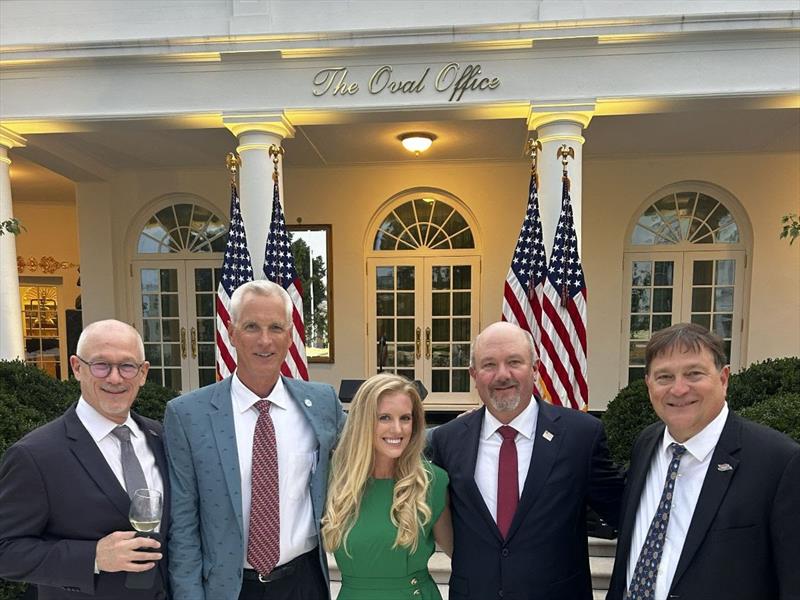
Industry leaders joined President Trump at the Rose Garden Ceremony. From left to right: Frank Hugelmeyer, Glenn Hughes, Jess Turner (President, Outdoor Recreation Roundtable), Brian Nesvick (Director, USFWS), Ben Speciale (President, Yamaha Marine) © American Sportfishing Association
President Trump announced the "Restoring America's Saltwater Angling and Recreation" Executive Order in the White House Rose Garden Thursday night.
The order establishes a national policy to elevate marine recreational fishing in federal fisheries management and directs federal agencies to pursue better data and more modern management approaches, strengthen State-Federal partnerships, remove unnecessary barriers to access and advance innovative solutions for American anglers.
"This Executive Order is a historic recognition of what millions of American anglers and coastal communities have known for decades: marine recreational fishing deserves a management system built for the way Americans fish," said Jeff Angers, president of the Center for Sportfishing Policy. "By prioritizing better data, stronger state partnerships and modern management approaches, President Trump's order builds on our conservation gains creating a path to more reliable access and opportunity in America's oceans."
"The American Sportfishing Association thanks President Trump for this decisive action to improve management and data collection for America's saltwater fisheries," added Glenn Hughes, president and CEO of the American Sportfishing Association. "This Executive Order will have long-term benefits for the sportfishing industry and America's 15.5 million saltwater recreational anglers."
Under the Executive Order, federal agencies are directed, consistent with existing law, to:
- Modernize recreational fisheries data collection by evaluating outdated survey methods, expanding electronic and mobile reporting and incorporating real-time catch, effort and observational data into federal fisheries management;
- Strengthen State-Federal partnerships and improve the use of state data, including consideration of more precise state recreational catch-and-effort data in federal management decisions;
- Improve recreational fisheries economic data so the economic value of recreational fishing, for-hire fisheries and shoreside businesses is more fully considered in federal fisheries management decisions;
- Advance technology-based approaches to marine mammal avoidance, including directing NOAA to work with the private sector to integrate new technologies that can improve marine mammal detection and avoidance;
- Fast-track artificial reef and habitat creation, including establishing a federal Reef-in-Place Program for eligible offshore structures and streamlining permitting for qualifying artificial reef projects, and
- Address shark and pinniped depredation and their impacts on recreational fishing by improving research and coordination among federal and state fisheries managers, anglers and the recreational fishing community and advancing management strategies to reduce harmful interactions.
The order also directs federal agencies to streamline permitting, remove administrative barriers to recreational fishing and habitat projects, improve the delivery of Dingell-Johnson Sport Fish Restoration funds, and strengthen coordination of habitat restoration efforts.
The order builds on a bipartisan history of presidential support for recreational fishing. President Bill Clinton issued Executive Order 12962 in 1995 establishing recreational fishing as a federal policy priority. President George W. Bush strengthened that order in 2008 by explicitly protecting recreational fishing as a sustainable activity on federal lands and waters.
This Executive Order recognizes the significant economic contributions of America's outdoor recreation, noting that the sector generates more than $1.2 trillion annually, supports 5.2 million jobs and accounts for 2.4 percent of U.S. GDP. Recreational boating and fishing are the nation's largest conventional outdoor recreation activity, contributing $38.4 billion in value added to the U.S. economy. Saltwater recreational fishing alone generates $145.4 billion in sales impacts and supports nearly 700,000 jobs nationwide.
"President Trump is sending a clear message that America's saltwater anglers matter. Better data, modern management and stronger state partnerships can deliver what anglers and coastal communities have needed for years: healthier public fisheries and more reliable access to them," Angers continued.
"Recreational boating and fishing are the foundation of America's outdoor heritage and an important driver of our nation's recreation economy," said Frank Hugelmeyer, president and CEO of the National Marine Manufacturers Association. "Today's actions further reaffirm the importance of ensuring Americans can access and enjoy our nation's waters. Access supports American manufacturing, jobs and small businesses across the country. Thank you to President Trump and his administration for recognizing the value of outdoor recreation and the American industries and communities it supports."
"We're grateful the Administration has taken this opportunity to emphasize the social and economic importance of recreational fishing," said Pat Murray, president and CEO of Coastal Conservation Association. "State-based management has never been more important for our federal fisheries, and we applaud this critical need being highlighted in this Executive Order."
"America's anglers were among the nation's first and most dedicated conservationists, and this Executive Order recognizes that commitment while charting a path towards increased access to healthy fisheries," said Jeff Crane, president and CEO of the Congressional Sportsmen's Foundation. "We thank President Trump for elevating recreational fishing as a national priority and look forward to working with the Administration to turn these directives into meaningful results on the water."
ASA and our partners have long advocated for federal fisheries policies that recognize the distinct nature of recreational fishing, improve the quality and use of data, promote innovation and provide meaningful public access to sustainably managed marine resources.