
Collaboration key to South Africa's boatbuilding future
by African Boating Conference 22 Oct 10:50 PDT
20-21 October 2026
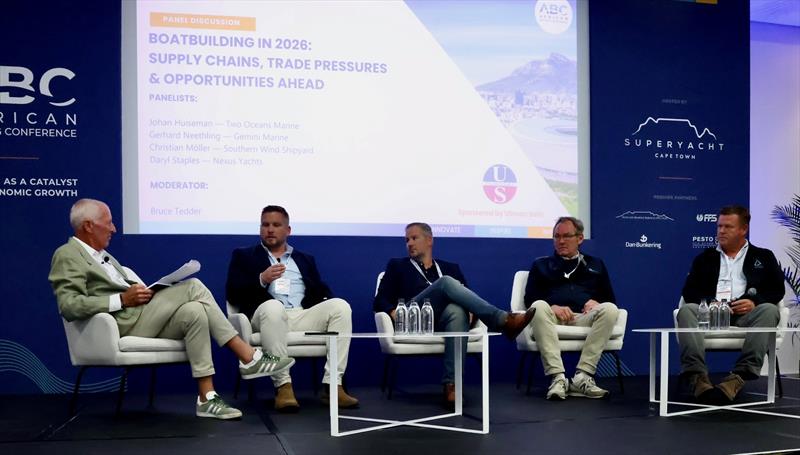
Boat Building Panel © African Boating Conference
Innovation, skills development, stronger industry partnerships and government support are essential to maintaining South Africa's position in the global boatbuilding market, according to industry leaders speaking at the African Boating Conference in Cape Town.
South Africa's boatbuilding industry has established an international reputation for quality, craftsmanship and innovation. However, rising production costs, skills shortages, international trade pressures and growing competition are placing increasing demands on manufacturers to improve productivity and remain competitive.
These challenges were explored during the Boatbuilding in 2026 - Supply Chains, Trade Pressures & Opportunities Ahead panel at the African Boating Conference, moderated by Bruce Tedder, Chairman of the South African Boat Builders Export Council (SABBEX).
The discussion brought together four leading South African boatbuilders: Johan Huisman, Two Oceans Marine Manufacturing; Gerhard Neethling, Gemini Marine; Christian Möller, Southern Wind; Daryl Staples, Nexus Yachts.
Representing different sectors of the industry, the panellists shared perspectives on the challenges of manufacturing world-class vessels in South Africa and the opportunities to strengthen the country's international competitiveness.
A central theme was that innovation does not necessarily require expensive technology or major capital investment. Often, the greatest improvements come from closer collaboration between boatbuilders, designers, suppliers and customers to identify practical solutions that improve efficiency, reduce waste and streamline production.
Examples discussed included the use of 3D scanning technology to improve manufacturing accuracy and accelerate production. In superyacht construction, combining digital measurement with advanced filler application techniques could potentially reduce a traditionally lengthy finishing process from nine to twelve months to just three to six months.
Advances in sustainable materials are also opening new opportunities, with one example demonstrating how approximately 46% of a material can be derived from sustainably sourced wood pulp rather than fossil fuel-based inputs.
However, technology alone is not the answer. Skills shortages, high equipment costs, inefficient production processes and increasing competition from Asian manufacturers remain significant challenges.
The discussion cautioned against simply adopting European manufacturing models without considering South Africa's operating environment. Instead, the industry needs solutions suited to local workforce capabilities, supported by targeted training, mentorship and the practical application of new technologies.
Government support and international trade advocacy also remain critical to the industry's future. The continued engagement of Cape Town's Alderman James Vos and Western Cape Premier Alan Winde reflects continued recognition of boatbuilding as an important contributor to exports, investment, economic development and skilled employment.
Premier Winde's efforts to engage the United States on trade tariffs are particularly significant given the importance of the American market to South African boatbuilders. Advocacy for more favourable trading conditions highlights the need for government and industry to work together to protect export markets and sustain the sector's international competitiveness.
While external trade conditions remain a challenge, the panel reinforced that South Africa also has opportunities to strengthen its position through improvements within the industry itself.
Greater collaboration emerged as one of the most immediate opportunities for progress. Earlier engagement with suppliers, better production planning, sharing technical expertise and investing in the next generation of skilled workers could deliver meaningful productivity gains while building long-term manufacturing capacity.
South Africa's labour-intensive boatbuilding sector also has the potential to turn its skills base into a competitive advantage, combining craftsmanship and specialist expertise with smarter production methods and selective technology adoption.
The overarching message was that South Africa does not need to reinvent boatbuilding to continue competing internationally. By improving efficiency, strengthening partnerships and investing in people, while working alongside government to address international trade barriers, the industry can build on its established reputation and create further opportunities for economic growth and employment.
The African Boating Conference continues to provide an important platform for these discussions, bringing together manufacturers, suppliers, government representatives and industry leaders to address shared challenges and develop the partnerships needed to advance Africa's marine manufacturing sector.