
Innovation meets tradition: Newcastle Harbour Swim leads the way with MarkSetBot buoys
by Suzie Ryan 30 Mar 01:50 PDT
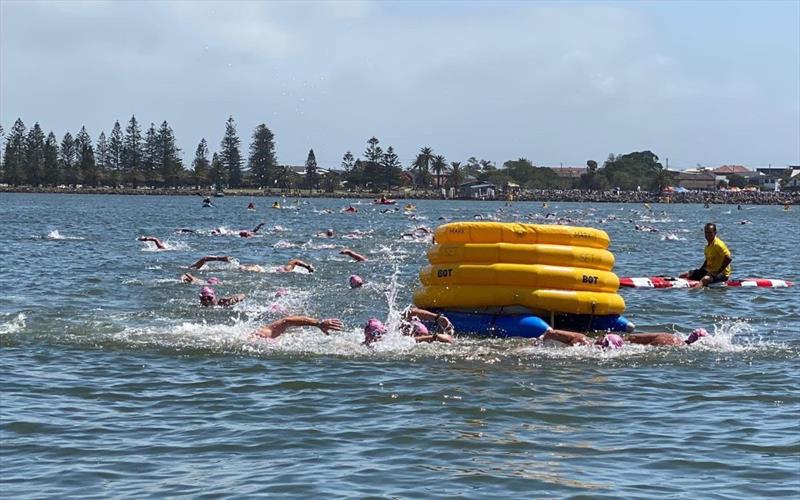
Newcastle Harbour Swim © Suzie Ryan
On Australia Day, the Newcastle Harbour Swim, hosted by Stockton Surf Life Saving Club, became the first ocean swim in Australia to use GPS-controlled MarkSetBot Buoys, the same technology seen at the America's Cup and SailGP, delivering unmatched course accuracy, visibility, and safety in challenging harbour conditions.
On Australia Day in Newcastle, it wasn't just swimmers making waves.
At the iconic Newcastle Harbour Swim, hosted by Stockton Surf Life Saving Club, history was quietly being made out on the water.
For the first time at an Australian ocean swim, the course wasn't marked by traditional anchored buoys. Instead, it was set by cutting-edge, GPS-controlled MarkSetBot Buoys, the same technology trusted on the world stage at events like the America's Cup and SailGP.
It was a bold move. But according to Stockton Surf Club President Jo-Anne Dryden, it was one driven by necessity.
When the harbour moves, so do the buoys
During the previous year's event, conditions proved challenging, prompting organisers to seek a reliable solution.
"The last time the harbour swim was held, we unfortunately experienced issues with the turning buoys' shifting position due to very strong currents and high winds," said Ms Dryden.
"This created obvious safety and course management concerns."
This year, with both events operating from the Stockton side, the first turning buoys needed to sit in the middle of the harbour, where the water runs deep, and currents can be unpredictable.
"These factors made traditional buoys and traditional anchoring methods more challenging and increased the risk of movement in adverse conditions," said Ms Dryden.
"Rather than accept the limitations, I decided to look for another way.
"I knew I needed to think outside the box, and this is where I was led to MarkSetBot."
Borrowing from the world's best
For sailors, Bot Buoys are nothing new. They've been used at the highest level of international racing, where precision is everything, and centimetres matter.
But for open water swimming? This was new territory.
"I will admit I was genuinely excited about being the first open water swim in Australia to use them," said Ms Dryden.
"Initially, I was a bit unsure about how they would work, but after speaking to Matt Butterworth and gaining a solid understanding of how they operated and seeing the technology in action, I knew that this could work for our swim.
"After seeing this, I decided to present this idea to our committee.
"There were initial questions, particularly around the fact that the buoys are propeller-driven, but once the committee saw demonstration footage and understood how the system works, their concerns were quickly eased, and they were eager to get them at the swim."
How do bot buoys actually work?
Unlike traditional buoys that rely on anchors and rope, Bot Buoys use GPS coordinates to hold their position on the water.
They're roughly one metre by one metre in size and sit about a metre high above the surface. Controlled through an app on a phone or tablet, organisers can set precise coordinates and even reposition the buoys in real time.
"Because they maintain their position electronically rather than relying solely on traditional anchoring, they provide an accurate and reliable course, even in challenging conditions," said Ms Dryden.
"Their visibility and their size make them easy for swimmers to spot, even in rough water, which is a significant advantage for both safety and navigation.
"For swimmers battling harbour chop or sighting into the sun, that extra height of the MarkSetBot Buoys made a huge difference."
A safer, smarter course
For race directors and water safety teams, shifting buoys aren't just frustrating, they're risky. A drifting marker can change a course mid-race, create confusion, and stretch safety resources.
With GPS-held positioning, that uncertainty disappears.
The result? A course that stays exactly where it's meant to be. And if conditions require change, flexibility is built in.
"We were running two different courses for the event, so both sets of GPS coordinates were pre-programmed into the app," said Ms Dryden.
"Once the first swim was completed, it was simply a matter of selecting the Bot Buoys on the app, dragging them to the new position, and the Bot Buoys automatically moved themselves.
"It's quite easy, no anchors lifted, no heavy ropes reset, and no boats scrambling to reposition buoys. It's just precision, at the tap of a screen."
Innovation without losing the spirit
For all the technology involved, the heart of the Newcastle Harbour Swim remained the same: community, challenge, and that uniquely Australian summer energy.
Swimmers and volunteers embraced the change.
"The response from both swimmers and volunteers was overwhelmingly positive," said Ms Dryden.
"The Bot Buoys generated a lot of interest and publicity, with swimmers and spectators alike impressed seeing them in action on the course.
"We will definitely be using them again next year, and I would highly recommend them for any ocean or harbour swim in place of a traditional buoyed course."
Find out more about MarkSetBot here.