
Rice students chart a new course for autonomous sailboat fleets
by Rice University 3 Jun 07:44 PDT
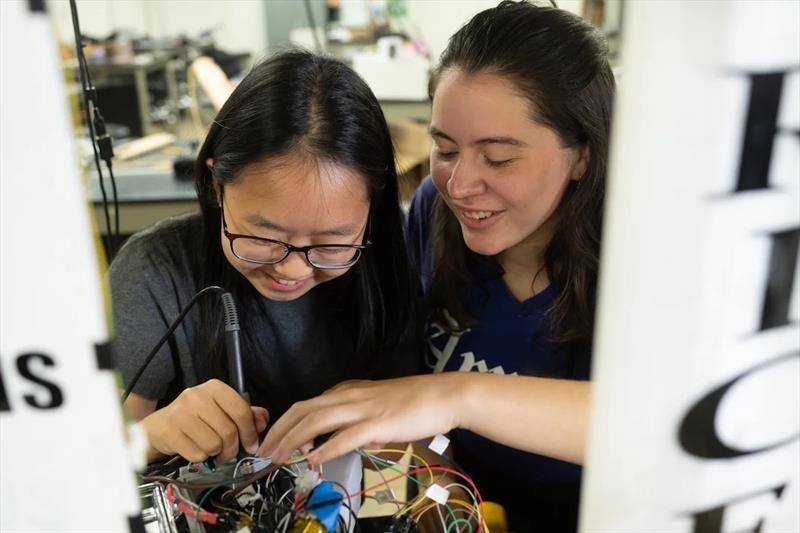
Rice University students chart a new course for autonomous sailboat fleets © Jeff Fitlow / Rice University
In a corner of Rice University's Oshman Engineering Design Kitchen (OEDK), a group of students is tackling a big idea: revolutionizing maritime transport with swarms of smart, self-sailing boats.
The project, aptly named FleetCode, is the latest iteration of an ambitious multiyear effort to design autonomous sail craft that could one day deliver cargo, map uncharted waters or support naval operations without a single crew member on board. Working under the guidance of faculty adviser David Trevas, the team is comprised of students Anna Tetreault, Connor Spears, Daniel Plascencia, Faith Mulugeta, Ilan Ezra, Ithzel Toscano, Jun Chu, Olamide Adeshola and Owen Baenen. They are sponsored and supported by the OEDK and won the Best Aerospace or Transportation Technology Award at the 2025 Huff OEDK Engineering Design Showcase and competition April 17.
"The big picture is to create a fleet of autonomous sailboats that can work together — like a swarm of drones but on water," said Baenen, a senior on the team.
This year's prototype is a compact 3-foot trimaran built from PLA plastic reinforced with fiberglass and resin for water resistance and structural stability. The trimaran design — a central hull flanked by two outriggers — offers enhanced balance on the water, reducing the risk of capsizing during rough conditions.
"It's designed to be modular," Plascencia said. "That means we can scale it up if needed, but the small size makes it easier to test things like obstacle detection and fleet dynamics."
The boat bristles with sensors: wind speed and direction gauges, GPS, a LiDAR system, a mounted camera and an inertial measurement unit. Together, these components enable the vessel to navigate autonomously, respond to environmental cues and avoid obstacles in real time.
"We use a global path planning algorithm to tell the boat where to go — from point A to point B using GPS coordinates," explained Chu, who helped program the vessel's control system. "If it detects an obstacle with the LiDAR or camera, it automatically recalculates its route."
Autonomy doesn't mean a lack of intelligence; rather, it indicates smart adaptability. FleetCode's boats can make decisions mid-journey, updating their routes in response to real-world conditions. Unlike gas-powered craft, these boats are designed for ultralow energy use. They rely on wind for propulsion and solar panels for powering onboard electronics.
"That combination — solar energy and sails — means these boats can stay out for long periods without needing human maintenance," Chu said. "That's perfect for things like low-priority cargo delivery or environmental monitoring."
One of the biggest innovations is the move from single-boat autonomy to fleet operations. That means multiple vessels can coordinate as a team, each one aware of the others, adjusting course and speed in sync much like how birds fly in formation or autonomous drones collaborate.
"It's not just about building a smart boat," Baenen said. "It's about building smart systems and getting these boats to behave intelligently together."
This year marked a first for the project: dedicated computer science majors joined the team's mechanical and electrical engineering students, bringing a new level of complexity to the codebase.
"Integrating all the sensors, navigation algorithms and hardware controls was a huge challenge," Baenen said. "But it's what makes the project so rewarding. It's a full systems integration problem."
FleetCode stands on the shoulders of previous student teams. In 2022, Rice students developed a 4-foot, semiautonomous catamaran as a proof of concept. Last year, Team Sea++ scaled that into a more robust 8-foot trimaran with global and local path planning and computer vision. This year's team focused on going smaller and more agile, testing out how multiple, semilow-fidelity boats could work together in real time.
"This is the third year of the project," Tetreault said. "We've been able to build on what came before us but also adapt it to new goals. It's really exciting to be part of that progression."
The team also recognizes the importance of keeping the project sustainable — both in terms of energy and institutional memory.
"Sometimes things get lost in transition between years," Baenen said. "If another team picks this up next year, we hope they can take our foundation and go even further, maybe focus more on data analytics or scaling up the system."
The potential applications for autonomous sail fleets are vast: delivering medical supplies to remote islands, conducting coastal mapping after hurricanes or even serving military logistics in contested waters, all with less risk to human life.
"Large, manned cargo ships are vulnerable targets," Tetreault said. "If you can replace that with small, inexpensive autonomous vessels, you change the game."